Book
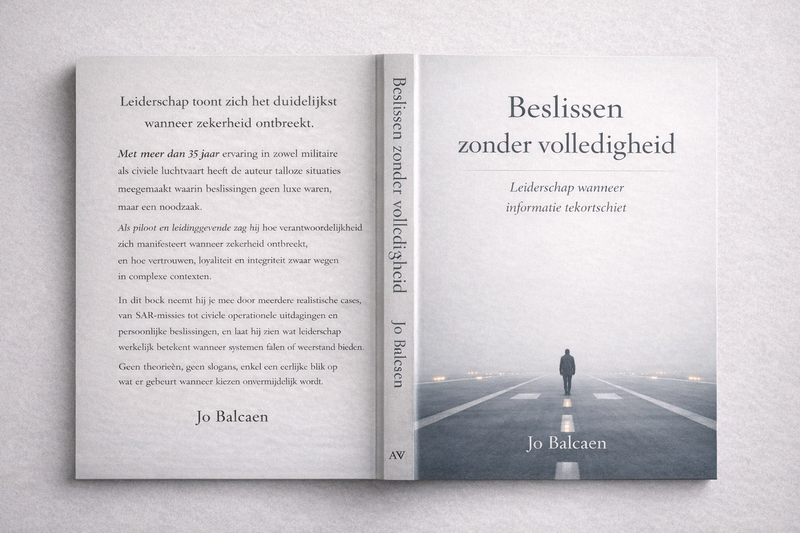
A reflective essay ("Beslissen zonder volledigheid - Deciding without completeness") exploring one central question:
"How do you take responsibility when completeness is absent?"
From that question unfolds everything else: operations, teams, culture, stress, and the moral weight of acting without guarantee.
The book does not treat leadership as control, rather it examines leadership as action taken within uncertainty.
The book provides language for conversations that many teams sense but rarely articulate.
–––––––––––––––––––
Uncertainty as the normal condition
In high reliability environments, uncertainty is not a disruption of the system. It is the condition under which the system operates.
Information rarely arrives in full, yet time does not pause and consequences develop while decisions are still forming.
Leadership does not begin when clarity appears. It begins when someone accepts that clarity may not arrive in time.
–––––––––––––––––––
Responsibility as weight
Responsibility cannot be perfectly distributed. Systems can divide roles and tasks, but when outcomes become concrete, the experience of responsibility settles somewhere specific.
There is always a moment when a decision moves from discussion to action. That moment leaves a trace. Not only operationally, but personally.
–––––––––––––––––––
Vigilance over perfection
In complex environments, perfection is irrelevant. What matters is the capacity to notice deviation and to adjust before drift becomes failure.
Correction requires attention. Attention requires discipline. Discipline requires the willingness to interrupt oneself when something no longer fits.
–––––––––––––––––––
The human factor
Structures provide boundaries; they do not remove human limits.
Judgment fluctuates, while energy declines. Experience helps but never guarantees. Silence sometimes protects, sometimes hides.
Reliable systems are not those that deny these limits, but those that account for them.
–––––––––––––––––––
Leadership as relational practice
Leadership does not occur in isolation. It emerges between people, in how doubt is handled, how disagreement is voiced, and how direction is articulated when comfort is no longer available.
Leadership is not dominance. It is the capacity to hold space when certainty dissolves.
–––––––––––––––––––
The movement in the book
The book moves deliberately:
From action
to understanding what makes action possible
to recognizing what action costs
to accepting where influence ends
It does not conclude in control, but in clarity.
–––––––––––––––––––
If captured in one sentence:
"Leadership begins where certainty ends, and becomes visible in how responsibility is carried within the limits of one’s influence — without hardening, withdrawing, or pretending certainty exists."
_____________________________________________________
If you would like to receive a message when the book becomes available, you can leave your email here.
